Showing posts with label Jewelry Roadtrip. Show all posts

Tuesday, August 11, 2015

European Snuffboxes

First off, I want to say a big THANK YOU for the support you all have shown on my social media channel. I would have never thought that there is such a big Antique family out there. When I first started my blog and instagram, it was just a place for me to organize my information and the things I have learned. However it has grown into so much more, it has become a place to share and exchange ideas with other jewelry enthusiasts.

A few days ago I made a trip to the Metropolitan Museum of Art in New York. It's a place I go to for inspiration and to spend time with myself. My destination was to visit the European Decorative Arts section. To my surprise, there were many snuff boxes in that section. Today’s post feature Snuff boxes from the 18th to 19th century.


I didn't know much about snuff boxes, it sounded to me like a box you sniff something out off. And I was right! Inhaling snuff, or snuffing as it's also called, was first witness by European in 1493 when Friar Ramón Pane, who had arrived in the new world was living as a missionary among Haiti’s indigenous Taino. Until then tobacco was unknown to Europeans, but during the 1500s the use of tobacco spread tremendously. By the late 17th century, ornate boxes were created to keep the precious powder dry.


Early 18th century, French jewelers made snuff boxes out of gold set with diamonds, amethysts, and sapphires. By 1740, specialized artisan took over the production of these ornate tabatières and engraved, chased, and enameled them. Below is a snuff box made out of gold, enamel and diamonds. ca. 1820. When wound up, the bird turns and flutters its wings while music plays. These "singing bird" boxes were especially popular in the East.


SHAPES:
Snuff boxes shapes were not limited to simple rectangles. The most common were porcelain containers resembling trunks, so were ovals, but tabatières shaped like shells were more rare. The snuff box below is varicolored, gold and enameled. Signed: J.N (John Northam? active 1793) After William IV's accession in 1830, this otherwise plain box was embellished with an encrusted plaque bearing his monogram.


MEDIUM:
Sometimes these snuff boxes were hand painted. Pictures of miniature landscapes, bucolic scenes to tiny portraits or grisaille cameos of their owners could be seen. 

Silver snuff boxes are usually associated with Sheffield, England, where silver-plating technologies were more advanced in the late 18th century. Below is a 1750 Germany gold and mother-of-pearl snuff box. It's a gift of J. Pierpont Morgan. 


By the 19th century, the silver industry has blossomed in Birmingham, England. Box makers such as Samuel Pemberton, Nathaniel Mills, and Edward Smith were some of the many well-known container producers who produced images of castles and abbeys on the box tops and sides.


ABOVE: Gold, enamaled, ivory, glass snuffbox. Joseph- Etienne Blerzy (master 1768) Miniature attributed to Francios Dumont.


BELOW: Double Snuffbox. Gold, enamel, vellum, gouache, glass. Jean Ducrollay. Miniature portraits on all sides and inside the two covers of Louis XV, Marie Leszeznska, and their children. (1749-50)


Soon Birmingham became the center for papier-mâché snuff boxes, which were hardened by multiple layers of enamel. As the market for inexpensive boxes grew in the United States, Birmingham box makers were decorating their wares with portraits of U.S navel heroes and victory scenes from the War of 1812. Engravings from renowned American artists, Gilbert Stuart were their primary source material.


ABOVE: Gold, enamel snuffbox. Possible Pierre-Francois-Mathis de Beaulier. ca. 1764-65.

ABOVE: Gold, enamel, diamonds, glass snuffbox. Jean-Joseph Barriere, ca. 1782

Monday, July 27, 2015

Antique Jewelry and Watches Show, New York

As quoted by the great Albert Einstein, "I have no special talents. I am only passionately curious." Perhaps this might have applied to me. I know I love jewelry (who doesn't?) but I never knew I would actually be developing myself in the jewelry industry. It all started from my first jewelry history class back when I was in college. Learning about the different time periods opened my eyes to how jewelry adornment has changed. Then my curiosity to understand more about the jewelry industry led me to start a jewelry subscription service as a side project. From there I landed a job at Swarovski and other well-known companies for internship. However, it wasn't till I created this blog that I started to fell in love with antique jewelry, every piece is so unique and meaningful.


Today was the last day of the Antique Jewelry & Watch Show held in New York, Metropolitan Pavilion. I knew this was something I could not miss and I was right. The minute I stepped into this show I was mind blown. Never in my life have I seen gemstones as big as my thumb, and diamonds as bright as the stars. They were truly museum quality pieces. Below were some pieces that I managed to take photos of, I wish I hadn't been that shy and had taken more photos.


There were about 113 booths, and all the jewelry pieces were secured in glass cases and there were bodyguards standing at every corner to ensure the safety of the sellers and buyers. At the show you could find pieces from high luxury companies such as Van Cleef & Arpels, Tiffany & Co., David Webb, etc. It was amazing to see the pieces in person. As I grace the details of every piece with my eye I can imagine feeling the weight of each piece on my fingers. The price tag was extremely heavy yet I see people paying in cash with hundred dollar bills. One day I want a piece of jewelry like this in my collection too.


I was so happy to finally see David Webb's animal bracelet in person. Below is a zebra bracelet that's made out of gold and diamonds, colored with enamel and embellished with emerald eyes. Next to it is the platinum bracelet covered with diamonds and baguette cut emeralds.


One of my favorite booth was Lenore Dailey's booth. Lenore Dailey's collecting expertise spans from many time periods and countries- Victorian, Art Nouveau, Memento Mori, Georgian, Edwardian, Arts & Crafts, Art Deco, Retro. The first thing that caught my attention was how she displayed her booth. Instead of white light and silver glass frame, she used yellow light and yellow glass frame. This gave off a very welcoming vibe when I walked passed her booth. When I took her business card I realized I actually follow her on social media. After speaking with the sales specialist, I filled in a draw to try and win this ring below.

Personally I think antique ring boxes are so cute and meaningful, it feels like I am opening a treasure chest compared to ring boxes we get in fine jewelry stores made out of cardboard materials.


Below was another booth I came across. The owner Patricia Novissimo- Lowther Antiques is from London. She specialized in Georgian jewelry, and her philosophy is straight-forward-

"Everything I buy must touch my heart. It has to appeal to me as if I were buying it for myself. I also feel that I am only the guardian of the piece, I never own it. I am merely the caretaker until someone else takes over that charge. These beautiful pieces have been around for hundreds of years and will exist for many hundreds of years to come and so they pass thorough our lives, enhancing them with their spirit and beauty".


Have you seen the documentary about the 400 Million Bahia Emerald? If you haven't you should definitely check it out (below). Found hidden in the earth of Brazil in 2001, this emerald weighs 840 pounds and contain roughly 180,000 carts of emerald crystals, making it one of the largest emerald ever found. Many people have tried to claim ownership of it but it never went through, now it's said to sit in a vault waiting to be claimed.


So you can imagine when I see a jewelry with emeralds on it. It reminded me of this documentary I watched and the number of years and hardship it took to extract such a beautiful stone. Below is a choker made of platinum covered with diamonds and a cabochon cut emerald centerpiece.


Below were other pieces that caught my attention.


Knowing me, I took their brochure and collected the business cards from all my favorite booths. So which one was your favorite piece? 


Friday, July 24, 2015

Road Trip: Showplace Antique Center

You know as one ages, their interest change. I used to work around the corner of Showplace Antique Center and I never bothered to take a look inside. Now that my passion has developed in the jewelry industry it'll be a shame of me to not have been inside this antique center.

The four-floor retail arcade features 150 individually-owned shops that sells fine antique with guaranteed authenticity. Their most popular items are mostly jewelry, decorative items like lamps, paintings, and art pottery. There are some costume piece jewelry too. I can't say that their prices are cheap. According to Yelp reviews, their prices are in the double dollar sign. However I did came across many beautiful pieces that I wish I could keep for myself.


Every Sunday they have an estate auction that starts early in the morning. It was my first time at an auction, it's not as grand as Sotheby's auction but it's a start. I really wanted to feel involved so I took one of their catalogue and started writing down the price of each item, since that's what I saw the lady beside me doing. What is great about this auction is that it's quiet small, there's not that many people hence the pieces also goes out really fast. The pieces that went on auction that day were mostly decorative items such as furniture, lamps and paintings. Since I don't know much about antique pieces, I can't help but question the authenticity of them.


After finishing writing a full page of prices I decided to go upstairs. Like any antique stores, the second floor is filled with many items. You can see light fixtures hanging from the ceiling, beautiful big mirrors hanged up on the wall, and shiny jewelry behind glass boxes.


It was not long till this stunning ring (below) caught my attention. I stared at it for awhile before asking the sale specialist to let me try it on. Perhaps a poet would be best to describe the emotions I felt when I slide it onto my finger. The emerald and diamond are such great companion. According to the sale specialist, this ring was made in the 1960s. Sadly this ring came with a heavy price tag.


As I continued to wonder around the store, I came across these carefully displayed cameo jewelry. If you paid closed attention, you would have noticed that cameo pieces tend to be a woman's profile carved out of white shells against a coral background. I did a little research and found out that the pieces below were from the Victorian period. The most common motif is the portrait, usually it depicts a celebrity of the day- ruler, scholar or philosopher.


Than in the early 19th century, cameos started to feature anonymous Roman woman wearing no jewelry. On the other hand, lava cameos carved with mysterious woman's image were sought out by Victoria women on the Grand Tour- a travel rite passage for the upper-class European. Since then these Victorian women had a big influence on the cameos when they demanded a more familiar-looking lady, with thinner neck, her hair up and wearing jewelry. Below you can see a few pieces where the lady is wearing necklaces around their neck.


Below: I found this necklace interesting because when I see a head of a buddha it's often carved out of jade. So I thought it was unusual to see a buddha head carved out of coral. Somehow the coral is not as red as it could be, however it still looks beautiful nevertheless. If you like this necklace, here is a similar piece made of coral and pearls, I think it has a more fashionable look to it.


Below are more of my favorite pieces. From rings, to necklaces, to brooches and bracelets.

RINGS
Common materials in antique rings are platinum, gold, diamonds, pearls and gemstones.


EARRINGS
These 14K yellow gold earrings reminded me of David Webb gold pieces. There's a touch of antique style yet it's bald and barbaric in a sense. I always think that gold and diamonds are the best combination, however a few precious gemstones enhance the fun in a piece.


BRACELETS & BROOCHES


Monday, July 20, 2015

Jewelry Roadtrip: The Cloister

As quoted from Shannon L. Alder, "Life always begins with one step outside your comfort zone."
It might just be me or others have similar fear of venturing anywhere above 125th street in New York. However the beautiful photos of The Cloister Museum tempted me to take a leap of courage.

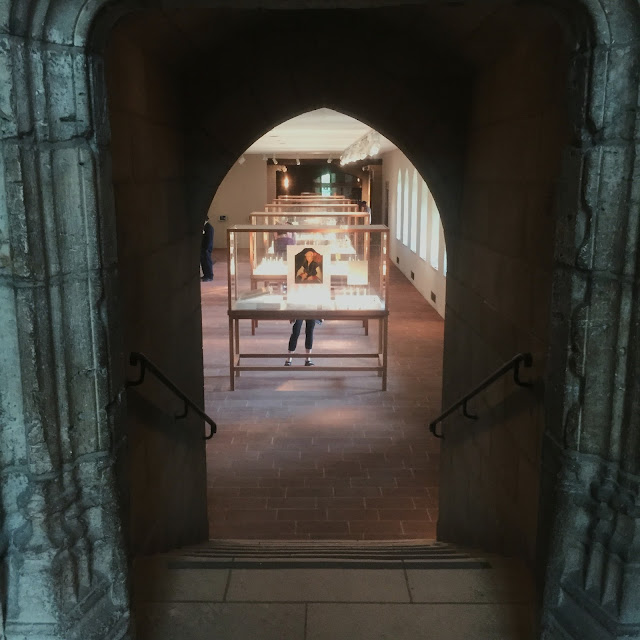
This museum is a branch of The Metropolitan Museum of Art dedicated to the art and architecture of medieval Europe, dating from the twelfth to the fifteen century- essentially the Romanesque and the Gothic period. Since this is a jewelry blog, let start with sharing some of my favorite jewelry pieces from the Middle Ages.


Techniques:
The rings below all dates back to the Middle Ages, one can imagine the amount of manual work that's put into every piece by the goldsmiths. The main materials used during this period was gold and silver where different techniques were used to create working surfaces and decoration. Popular techniques included granulation, filigree, enameling, and other techniques that would enhance the brilliance of the piece.


Designs:
It's unsure how the design of every piece came about during the Middle Ages. It's said that upon the fall of the Roman empire, design of jewelry became less important than the significance in the piece. Speed was desired over quality- perhaps because of trying to keep the monastery flourishing. While the majority of monks turned to framing and wine making, some of them turned to goldsmithing that was concentrated on ecclesiastical jewels. This type of jewelry (mostly rings) were worn by bishops to indicate their status. The ring band are often oversized because the ring had to be worn over gloved hands.


As mentioned earlier about the importance placed in significance jewelry, memento mori pieces are a good example. "Memento Mori" a latin phrase that translate to "remember death." This special category of jewelry emerged during the Renaissance, when goldsmiths and other artists developed moralistic images that contrasted youth and beauty with death and decay. These pieces seems to be a reminder for their owners to think about human existence, and the vanity of materialistic pursues.


Often you may see the juxtaposition of human body with skeletons (above), and sometimes messages were revealed through the use of hidden chambers. The image below is a ring that separates into two hoops. When opened, the paired bezels reveal two hidden chambers where one side is a curled up baby, and the other side is the baby skeleton. This is why I love hidden messages because it's up to the owner to find his/her own meaning in the piece. The inscription states, "Whom god has joined together, let no man tear asunder." If this doesn't send a chill down your spine, then I don't know what would.


Now that I have shared with you some of my favorite pieces from the Griffin Collection, it's time I share with you some of the spatial courtyards in the museum.

Below- Cuxa Cloister, Marble:
The medieval elements in this museum all come from the abbey of Saint-Michel-de-Cuxa, constructed between 1130 and 1146. The capitals are carved; the planes are simple and defined; and the decorative figural motifs provide strong visual support for the abaci and arcading above them.


The capitals (pillars) in this courtyard are decorated with figures blowing horns, beasts with half-swallowed men in their mouths, and lions devouring them.


Below- Saint-Guilhem Cloister, Limestone:
Just by looking at the capitals (pillars) one can immediately think of water. This monastery nestled in the landscape of gorges and waterfalls. Many of the capitals imitate the leaf forms of ancient Roman types; others appear as if covered by vines.


This capital is one of my favorite as I can imagine it looking really beautiful if made into a piece of jewelry.


Sadly my phone decided to run out of battery towards the end of my exploration, but that allowed me to be present in the moment rather than constantly taking photos. Being at this museum made me forget about the chaotic noise and busy streets of Manhattan. I could hear the birds chirping, the sounds of bugs and birds flying around. There's no words I could use to describe the peace I felt, perhaps I ought to consult a poet.


If you are visiting New York, be sure to check out The Cloister. Just like many other museums in New York, The Cloister museum is a "pay as you wish" place, meaning that you are not required to pay the full admission price. Above is a short video introducing The Cloister.

Related Posts Plugin for WordPress, Blogger...