Showing posts with label jewelry from the past. Show all posts

Saturday, August 29, 2015

Mystery Diamond Cuts Solved

With it being bridal season, and the increase of couples falling for vintage engagement rings. I have put together a list of the most popular vintage diamond cuts that I think would be helpful when your man buys you that engagement ring. ;)

ROSE CUTS
This cut dates to the 1500s and remained common during the Georgian (1714-and the Victorian Eras (1837-1901) The rose cut resembles a rosebud, with a flat bottom and dome-shaped crown that rises gently to a single apex, with between three and twenty-four facets. Because of the rose cut diamonds it give off a warm, romantic shimmer.  
Antique Georgian rose cut diamond cluster ring. Sold on 1stdibs.

Victorian Dahna Ring features seven rose cut diamonds. Sold on Brilliant Earth.

OLD MINE CUT
This cut dates to the 1700s and was also widely used during the Georgian and Victorian Eras.This cut was invented before the jewelers understood how light passes through the diamonds, therefore the old mine cuts were faceted around the natural edges of the diamond. Which explains it being less dazzling compared to modern cuts. The old mine cut is considered an early form of today’s cushion cut. 

 Victorian old mine cut diamond and sapphire ring. c. 1893. Sold on Bavier Brook
Old mine cut diamond ring featuring nine diamonds. 

OLD EUROPEAN CUT
The old European cut was first seen in the 1800s and was used often in Victorian engagement rings, Edwardian designs, and Art Nouveau styles. This cut typically features 58 facets and a circular shape. To understand the evolution of jewelers knowledge in diamonds, it’s best to study this cut as it’s been through many variations.

 Antique Edwardian ring featuring a 0.65 carat old european cut diamond. Sold on SOHO Jewelers.  

Platinum 1.43ct old european cut diamond ring. Sold on Raymond Lee Jewelers.

SINGLE CUT 
This is one of the oldest cut that dates back to the 1300s. The diamond features a flat top and an octagonal griddle, where the edge of the diamond is at its widest point. 
Single cut diamonds feature 18 facets, and you’ll often see small single cut diamonds accenting a center gemstone in antique rings from the early twentieth century when jewelers still lacked the ability to create many facets in tiny gems. 
 Sapphire and diamond ring. c. 1920, 6.26ct sapphire surrounded by 18 single cut stones.


The diagram below gives a clearer idea of how the cuts are done on the diamonds. I can't say that I have a personal favorite between these cuts, I think they are all unique and give off a different vintage vibe. Which ones are your favorite?

Saturday, July 25, 2015

Jewelry boxes from the past

For many vintage/antique jewelry collectors, it may have occurred to them that a jewelry box is a must to store their precious jewelry. I have been obsessing over beautiful vintage jewelry box for quiet some time now, and I find Etsy to be a great place to browse the options. Below are jewelry boxes that I have picked out to share with you because I think they are unique and beautiful.

Jewelry boxes were once designed like treasure chest because they were used by the royalty, priests, and aristocrats who could afford to own valuables. However during the Industrial Revolution, fine jewelry became affordable for the middle class, and jewelry boxes started to be mass produced. You could find boxes made for single rings, multiple rings and boxes designed for jewelry and accessories. Some contained mirrors, clocks, or mechanical music-makers, while others had multiple compartments, drawers or trays.

Mid-century Ornate silverplate jewelry box sold by GoodPennyDesigns.

CASKET JEWELRY BOX:
These kind of jewelry box often come in the shape of a rectangle, and is made of inlaid or carved wood, metal, porcelain, button-pressed glass, or plastics like celluloid or Lucite. Others are shaped like squat cylinders with feet, heart-shaped boxes, egg-shaped containers, or human figurines.

Antique Jewelry Casket Brass Box- Ormolu Repossé Souvenir of France, 1900-1909. Sold by DanetteDarbonne.

In the early 1900s metal jewelry caskets flourished and was mass-produced in Europe and sold to U.S customers. The boxes (cast of antimonial lead) were electroplated in copper and finished in silver or gold with names like French Bronze, Roman Gold, Pompeian Gold, French Gray, and Parisian Silver. The inside you would find it lined with velvet, satin, faille, or silk.

Vintage Gold Filigree Casket Jewelry Box from 1960s, sold by bohemiansoulshine

TRINKET BOX:
The trinket box is a sibling of the casket jewelry box. These kind of jewelry box are embraced by the Victorians as they collect curiosities, souvenirs, gadgets, and other knick-knacks. The illustrations often featured miniature figures of kids, flowers, or animals on the lids. It kind of reminds me of disneyland. The most popular and probably the most expensive trinket boxes were created for the Russian Tsar from 1890s to early 1900s. You can read more about trinket boxes here.
Blue Trinket Jewelry Sewing Box- Arlequin Pierrot Colombine Decor, French Antique 1930, sold by FrenchAntiqueBoutique

French Antique Tobacco Box, Art Nouveau, 1920s, sold by TheGentlemansBlade

Antique Islamic Koran Quran Jewelry Enamel Box Holder, 1950s, sold by Acrazeelady

ART NOUVEAU MOVEMENT:
As the naturalistic Art Nouveau movement emerges, it led to flowing organic motifs, such as sinewy flowers, fluttering birds, and beautiful women. Keeping with Victorian tradition, the type of flowers on the jewelry box could represent a coded romantic message: four-leaf clovers meant good luck, daisies meant innocence, and roses were for love. (Below is just an example of a jewelry box with floral designs and not from the Victorian Era.)

Vintage Ormolu Gold Filigree Footed Jewelry Box Floral Design, 1950s. Sold by Junkbay

Filigree bronze and colored glass jewelry box, circa 1800's - early 1900's. Sold by arusantiques.

Godinger Silver Plated Jewelry Box, 1980s sold by GiftsByIrisWithLove

Wood is also one of the many materials used to make jewelry boxes. The texture gives off a crafty touch.
Vintage Italian Wedding Ring Box, Florentine Gold Gilt Wooden trinket box, 1950s. Sold by millyscollection.

Vintage Box, S.F. Hess & Co. sold by RustbeltTreasures
Antique Japanese Black Fine Cloisonne Box Early Century Birds and Floral, 1920s, sold by LotusInTheWind

Antique Beveled Glass Jewelry Box with Filigree Vanity Mirror, sold by LuxuryCityAntiques

Antique Egyptian Nile Goose/Pintail Duck GEB Decorative Glass Mosaic Keepsake Box, 1930. sold by CASAdeORO


Monday, July 20, 2015

Jewelry Roadtrip: The Cloister

As quoted from Shannon L. Alder, "Life always begins with one step outside your comfort zone."
It might just be me or others have similar fear of venturing anywhere above 125th street in New York. However the beautiful photos of The Cloister Museum tempted me to take a leap of courage.

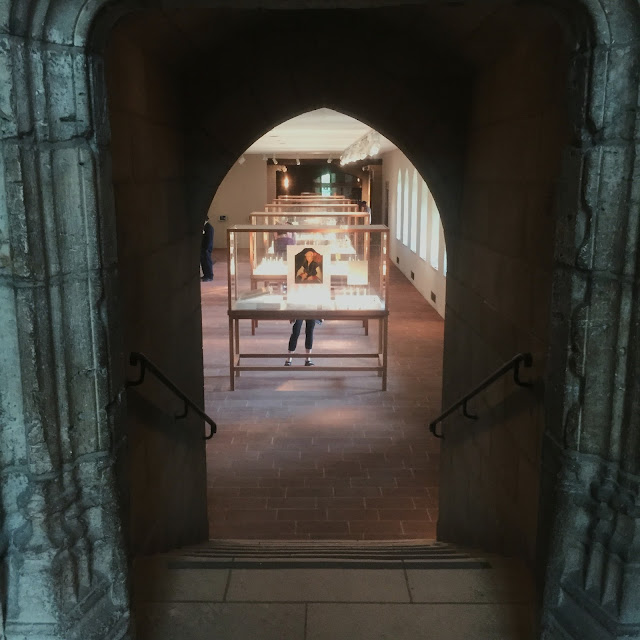
This museum is a branch of The Metropolitan Museum of Art dedicated to the art and architecture of medieval Europe, dating from the twelfth to the fifteen century- essentially the Romanesque and the Gothic period. Since this is a jewelry blog, let start with sharing some of my favorite jewelry pieces from the Middle Ages.


Techniques:
The rings below all dates back to the Middle Ages, one can imagine the amount of manual work that's put into every piece by the goldsmiths. The main materials used during this period was gold and silver where different techniques were used to create working surfaces and decoration. Popular techniques included granulation, filigree, enameling, and other techniques that would enhance the brilliance of the piece.


Designs:
It's unsure how the design of every piece came about during the Middle Ages. It's said that upon the fall of the Roman empire, design of jewelry became less important than the significance in the piece. Speed was desired over quality- perhaps because of trying to keep the monastery flourishing. While the majority of monks turned to framing and wine making, some of them turned to goldsmithing that was concentrated on ecclesiastical jewels. This type of jewelry (mostly rings) were worn by bishops to indicate their status. The ring band are often oversized because the ring had to be worn over gloved hands.


As mentioned earlier about the importance placed in significance jewelry, memento mori pieces are a good example. "Memento Mori" a latin phrase that translate to "remember death." This special category of jewelry emerged during the Renaissance, when goldsmiths and other artists developed moralistic images that contrasted youth and beauty with death and decay. These pieces seems to be a reminder for their owners to think about human existence, and the vanity of materialistic pursues.


Often you may see the juxtaposition of human body with skeletons (above), and sometimes messages were revealed through the use of hidden chambers. The image below is a ring that separates into two hoops. When opened, the paired bezels reveal two hidden chambers where one side is a curled up baby, and the other side is the baby skeleton. This is why I love hidden messages because it's up to the owner to find his/her own meaning in the piece. The inscription states, "Whom god has joined together, let no man tear asunder." If this doesn't send a chill down your spine, then I don't know what would.


Now that I have shared with you some of my favorite pieces from the Griffin Collection, it's time I share with you some of the spatial courtyards in the museum.

Below- Cuxa Cloister, Marble:
The medieval elements in this museum all come from the abbey of Saint-Michel-de-Cuxa, constructed between 1130 and 1146. The capitals are carved; the planes are simple and defined; and the decorative figural motifs provide strong visual support for the abaci and arcading above them.


The capitals (pillars) in this courtyard are decorated with figures blowing horns, beasts with half-swallowed men in their mouths, and lions devouring them.


Below- Saint-Guilhem Cloister, Limestone:
Just by looking at the capitals (pillars) one can immediately think of water. This monastery nestled in the landscape of gorges and waterfalls. Many of the capitals imitate the leaf forms of ancient Roman types; others appear as if covered by vines.


This capital is one of my favorite as I can imagine it looking really beautiful if made into a piece of jewelry.


Sadly my phone decided to run out of battery towards the end of my exploration, but that allowed me to be present in the moment rather than constantly taking photos. Being at this museum made me forget about the chaotic noise and busy streets of Manhattan. I could hear the birds chirping, the sounds of bugs and birds flying around. There's no words I could use to describe the peace I felt, perhaps I ought to consult a poet.


If you are visiting New York, be sure to check out The Cloister. Just like many other museums in New York, The Cloister museum is a "pay as you wish" place, meaning that you are not required to pay the full admission price. Above is a short video introducing The Cloister.

Related Posts Plugin for WordPress, Blogger...