Saturday, July 25, 2015

Jewelry boxes from the past

For many vintage/antique jewelry collectors, it may have occurred to them that a jewelry box is a must to store their precious jewelry. I have been obsessing over beautiful vintage jewelry box for quiet some time now, and I find Etsy to be a great place to browse the options. Below are jewelry boxes that I have picked out to share with you because I think they are unique and beautiful.

Jewelry boxes were once designed like treasure chest because they were used by the royalty, priests, and aristocrats who could afford to own valuables. However during the Industrial Revolution, fine jewelry became affordable for the middle class, and jewelry boxes started to be mass produced. You could find boxes made for single rings, multiple rings and boxes designed for jewelry and accessories. Some contained mirrors, clocks, or mechanical music-makers, while others had multiple compartments, drawers or trays.

Mid-century Ornate silverplate jewelry box sold by GoodPennyDesigns.

CASKET JEWELRY BOX:
These kind of jewelry box often come in the shape of a rectangle, and is made of inlaid or carved wood, metal, porcelain, button-pressed glass, or plastics like celluloid or Lucite. Others are shaped like squat cylinders with feet, heart-shaped boxes, egg-shaped containers, or human figurines.

Antique Jewelry Casket Brass Box- Ormolu Repossé Souvenir of France, 1900-1909. Sold by DanetteDarbonne.

In the early 1900s metal jewelry caskets flourished and was mass-produced in Europe and sold to U.S customers. The boxes (cast of antimonial lead) were electroplated in copper and finished in silver or gold with names like French Bronze, Roman Gold, Pompeian Gold, French Gray, and Parisian Silver. The inside you would find it lined with velvet, satin, faille, or silk.

Vintage Gold Filigree Casket Jewelry Box from 1960s, sold by bohemiansoulshine

TRINKET BOX:
The trinket box is a sibling of the casket jewelry box. These kind of jewelry box are embraced by the Victorians as they collect curiosities, souvenirs, gadgets, and other knick-knacks. The illustrations often featured miniature figures of kids, flowers, or animals on the lids. It kind of reminds me of disneyland. The most popular and probably the most expensive trinket boxes were created for the Russian Tsar from 1890s to early 1900s. You can read more about trinket boxes here.
Blue Trinket Jewelry Sewing Box- Arlequin Pierrot Colombine Decor, French Antique 1930, sold by FrenchAntiqueBoutique

French Antique Tobacco Box, Art Nouveau, 1920s, sold by TheGentlemansBlade

Antique Islamic Koran Quran Jewelry Enamel Box Holder, 1950s, sold by Acrazeelady

ART NOUVEAU MOVEMENT:
As the naturalistic Art Nouveau movement emerges, it led to flowing organic motifs, such as sinewy flowers, fluttering birds, and beautiful women. Keeping with Victorian tradition, the type of flowers on the jewelry box could represent a coded romantic message: four-leaf clovers meant good luck, daisies meant innocence, and roses were for love. (Below is just an example of a jewelry box with floral designs and not from the Victorian Era.)

Vintage Ormolu Gold Filigree Footed Jewelry Box Floral Design, 1950s. Sold by Junkbay

Filigree bronze and colored glass jewelry box, circa 1800's - early 1900's. Sold by arusantiques.

Godinger Silver Plated Jewelry Box, 1980s sold by GiftsByIrisWithLove

Wood is also one of the many materials used to make jewelry boxes. The texture gives off a crafty touch.
Vintage Italian Wedding Ring Box, Florentine Gold Gilt Wooden trinket box, 1950s. Sold by millyscollection.

Vintage Box, S.F. Hess & Co. sold by RustbeltTreasures
Antique Japanese Black Fine Cloisonne Box Early Century Birds and Floral, 1920s, sold by LotusInTheWind

Antique Beveled Glass Jewelry Box with Filigree Vanity Mirror, sold by LuxuryCityAntiques

Antique Egyptian Nile Goose/Pintail Duck GEB Decorative Glass Mosaic Keepsake Box, 1930. sold by CASAdeORO


Friday, July 24, 2015

Road Trip: Showplace Antique Center

You know as one ages, their interest change. I used to work around the corner of Showplace Antique Center and I never bothered to take a look inside. Now that my passion has developed in the jewelry industry it'll be a shame of me to not have been inside this antique center.

The four-floor retail arcade features 150 individually-owned shops that sells fine antique with guaranteed authenticity. Their most popular items are mostly jewelry, decorative items like lamps, paintings, and art pottery. There are some costume piece jewelry too. I can't say that their prices are cheap. According to Yelp reviews, their prices are in the double dollar sign. However I did came across many beautiful pieces that I wish I could keep for myself.


Every Sunday they have an estate auction that starts early in the morning. It was my first time at an auction, it's not as grand as Sotheby's auction but it's a start. I really wanted to feel involved so I took one of their catalogue and started writing down the price of each item, since that's what I saw the lady beside me doing. What is great about this auction is that it's quiet small, there's not that many people hence the pieces also goes out really fast. The pieces that went on auction that day were mostly decorative items such as furniture, lamps and paintings. Since I don't know much about antique pieces, I can't help but question the authenticity of them.


After finishing writing a full page of prices I decided to go upstairs. Like any antique stores, the second floor is filled with many items. You can see light fixtures hanging from the ceiling, beautiful big mirrors hanged up on the wall, and shiny jewelry behind glass boxes.


It was not long till this stunning ring (below) caught my attention. I stared at it for awhile before asking the sale specialist to let me try it on. Perhaps a poet would be best to describe the emotions I felt when I slide it onto my finger. The emerald and diamond are such great companion. According to the sale specialist, this ring was made in the 1960s. Sadly this ring came with a heavy price tag.


As I continued to wonder around the store, I came across these carefully displayed cameo jewelry. If you paid closed attention, you would have noticed that cameo pieces tend to be a woman's profile carved out of white shells against a coral background. I did a little research and found out that the pieces below were from the Victorian period. The most common motif is the portrait, usually it depicts a celebrity of the day- ruler, scholar or philosopher.


Than in the early 19th century, cameos started to feature anonymous Roman woman wearing no jewelry. On the other hand, lava cameos carved with mysterious woman's image were sought out by Victoria women on the Grand Tour- a travel rite passage for the upper-class European. Since then these Victorian women had a big influence on the cameos when they demanded a more familiar-looking lady, with thinner neck, her hair up and wearing jewelry. Below you can see a few pieces where the lady is wearing necklaces around their neck.


Below: I found this necklace interesting because when I see a head of a buddha it's often carved out of jade. So I thought it was unusual to see a buddha head carved out of coral. Somehow the coral is not as red as it could be, however it still looks beautiful nevertheless. If you like this necklace, here is a similar piece made of coral and pearls, I think it has a more fashionable look to it.


Below are more of my favorite pieces. From rings, to necklaces, to brooches and bracelets.

RINGS
Common materials in antique rings are platinum, gold, diamonds, pearls and gemstones.


EARRINGS
These 14K yellow gold earrings reminded me of David Webb gold pieces. There's a touch of antique style yet it's bald and barbaric in a sense. I always think that gold and diamonds are the best combination, however a few precious gemstones enhance the fun in a piece.


BRACELETS & BROOCHES


Monday, July 20, 2015

Jewelry Roadtrip: The Cloister

As quoted from Shannon L. Alder, "Life always begins with one step outside your comfort zone."
It might just be me or others have similar fear of venturing anywhere above 125th street in New York. However the beautiful photos of The Cloister Museum tempted me to take a leap of courage.

This museum is a branch of The Metropolitan Museum of Art dedicated to the art and architecture of medieval Europe, dating from the twelfth to the fifteen century- essentially the Romanesque and the Gothic period. Since this is a jewelry blog, let start with sharing some of my favorite jewelry pieces from the Middle Ages.


Techniques:
The rings below all dates back to the Middle Ages, one can imagine the amount of manual work that's put into every piece by the goldsmiths. The main materials used during this period was gold and silver where different techniques were used to create working surfaces and decoration. Popular techniques included granulation, filigree, enameling, and other techniques that would enhance the brilliance of the piece.


Designs:
It's unsure how the design of every piece came about during the Middle Ages. It's said that upon the fall of the Roman empire, design of jewelry became less important than the significance in the piece. Speed was desired over quality- perhaps because of trying to keep the monastery flourishing. While the majority of monks turned to framing and wine making, some of them turned to goldsmithing that was concentrated on ecclesiastical jewels. This type of jewelry (mostly rings) were worn by bishops to indicate their status. The ring band are often oversized because the ring had to be worn over gloved hands.


As mentioned earlier about the importance placed in significance jewelry, memento mori pieces are a good example. "Memento Mori" a latin phrase that translate to "remember death." This special category of jewelry emerged during the Renaissance, when goldsmiths and other artists developed moralistic images that contrasted youth and beauty with death and decay. These pieces seems to be a reminder for their owners to think about human existence, and the vanity of materialistic pursues.


Often you may see the juxtaposition of human body with skeletons (above), and sometimes messages were revealed through the use of hidden chambers. The image below is a ring that separates into two hoops. When opened, the paired bezels reveal two hidden chambers where one side is a curled up baby, and the other side is the baby skeleton. This is why I love hidden messages because it's up to the owner to find his/her own meaning in the piece. The inscription states, "Whom god has joined together, let no man tear asunder." If this doesn't send a chill down your spine, then I don't know what would.


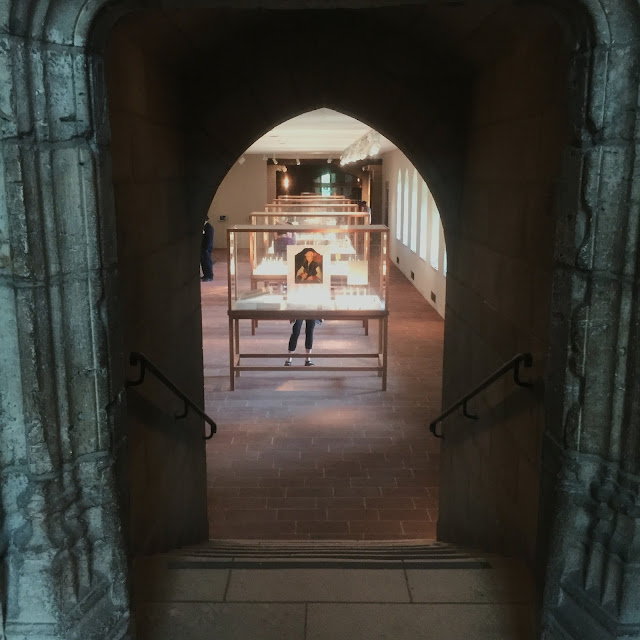
Now that I have shared with you some of my favorite pieces from the Griffin Collection, it's time I share with you some of the spatial courtyards in the museum.

Below- Cuxa Cloister, Marble:
The medieval elements in this museum all come from the abbey of Saint-Michel-de-Cuxa, constructed between 1130 and 1146. The capitals are carved; the planes are simple and defined; and the decorative figural motifs provide strong visual support for the abaci and arcading above them.


The capitals (pillars) in this courtyard are decorated with figures blowing horns, beasts with half-swallowed men in their mouths, and lions devouring them.


Below- Saint-Guilhem Cloister, Limestone:
Just by looking at the capitals (pillars) one can immediately think of water. This monastery nestled in the landscape of gorges and waterfalls. Many of the capitals imitate the leaf forms of ancient Roman types; others appear as if covered by vines.


This capital is one of my favorite as I can imagine it looking really beautiful if made into a piece of jewelry.


Sadly my phone decided to run out of battery towards the end of my exploration, but that allowed me to be present in the moment rather than constantly taking photos. Being at this museum made me forget about the chaotic noise and busy streets of Manhattan. I could hear the birds chirping, the sounds of bugs and birds flying around. There's no words I could use to describe the peace I felt, perhaps I ought to consult a poet.


If you are visiting New York, be sure to check out The Cloister. Just like many other museums in New York, The Cloister museum is a "pay as you wish" place, meaning that you are not required to pay the full admission price. Above is a short video introducing The Cloister.

Sunday, July 19, 2015

Jewelry Roadtrip: Pippin Vintage Jewelry

Having lived in New York for quite some time now and I haven't fully explored the gallaries and antique/vintage shops this city has to offer. So today I embarked on a mission to Chelsea in search of antique boutiques. Pippin Vintage Jewelry was one of the many stops on my list. This cute vintage boutique lies in the heart of Chelsea. The outside looks like any vintage stores you'll see in the East Village. However, upon entering the store I felt like I was in a different world. I was happy to know that they were camera friendly because I really wanted to share this place with you.

Even their business card has this personal touch to it. Running my fingers through the textured, cursive "Pippin" imprint somehow brought me back to a different period in time.

Their jewelry displays were so beautiful too. The use of mirrored displays help reflect the light which added more sparkle to the jewelry. Below are some cameo pieces; brooches, bracelets and rings.


This was one of the many pieces I fell in love with. I was under the impression that all the pieces in their store were higher-end merchandise however after speaking with one of the sales specialist regarding this piece below, I was told that it's actually costume jewelry that's gold plated with a jade as the centerpiece. That explains the affordable pricing of some of their pieces. Nevertheless, I love the oceanic vibe of this ring.


Same goes for this ring below. I have a thing for sapphires and diamonds. There's this royalty to it and it reminds me of Kate Middleton's engagement ring. The description states that it's made out of sterling silver.


Even though I didn't end up making a purchase I would definitely come back again and see what new pieces they have in store. If you haven't been to this store, be sure to drop by and take a peep, and see what the owner Stephen and Rachel have done.


Saturday, July 18, 2015

Tips you need to know before buying antique jewelry


There are many reasons to love antique jewelry. Myself for example have recently fell in love with antique pieces, however as a antique "noob" it's hard to tell whether the ones I bought are real. They say knowledge is power, therefore I found it important to do some research so I don't end up over paying for something manufactured in the assembly line. Below are some tips I found pretty useful:

Ask the right questions
One thing I found very helpful is to ask how the seller came across a piece. Everybody loves jewelry with a story behind it. Not only that, a good seller are able to provide some information as to where the pieces came from, along with general information on the date and location the piece was acquired.

Check for hallmark
Almost all antique pieces have some form of hallmark behind it. If the piece is said to be made prior to 1950s, be sure to flip it over to check for some kind of mark, such as a small icon or initial. Over time you may start realizing the types of clasps and closures that the pieces should have, so if they are different it may indicate they have been altered. Repairs are usually done on the back, therefore the craftsmanship on the back should be the same level as the front. I came across this antique online encyclopedia which I think is very helpful for beginners.

The hands on phase
Nothing compares to actually getting out into the field and handling jewelry. This part is important because it allows you to put your book knowledge together with your eyes, brain and fingertips. If your area have any auction houses, trade shows...I'll recommend going to them and start talking to the jewelry specialists. If you're shy perhaps you could ask if they have any brochures you could take home and investigate the pieces more.

Never assume
Lastly, never assume that the pieces you find is extremely rare because there are many great pieces out there from different era. You can take a look at the video below to get a brief introduction to the different periods. Humans tend to wear what is considered acceptable, hence if it was a popular item from a period, there's a high possibility there are more of them somewhere. The point is really to do your research well, and go out to fields more, to see more, to talk to people more.

Thursday, July 16, 2015

Over The Door Jewelry Armoir

I often spend too much time starring at my storage spaces and thinking of ways to better organize my things. Especially this big bookshelf in my living room with a bunch of stuff just stacked inside. Next is this tray where I store my jewelry pieces, however recently I came across this Mirrored jewelry cabinet and immediately fell in love with it. I have been dying to get a mirror in my house but a mirror + jewelry = a big deal. After browsing through a few sites the prices ranges from $80~ to $100~. So I got mine from Bed Bath & Beyond since that was the cheapest I could find and it's not used.


I got the white one since I think it suits more with my door but most likely I would probably spray paint it to beige. And if you guys are into DIY instead, here is a DIY video you can try at home.


Or if you prefer classic bracelet and necklace holders, here is a DIY video on how you can make them.


Related Posts Plugin for WordPress, Blogger...